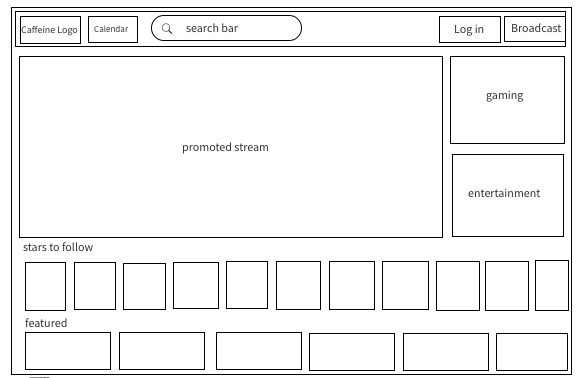
Caffeine’s UI

One of the first things you’ll notice about Caffeine’s website is that is very colorful and filled with all sorts of visuals. In some respects, it definitely resembles some of the popular social media platforms.  This is a good tactic being that most the younger generations, also being their targeted audience, are already familiar with the look and feel of that environment. The biggest thing about creating a successful or popular website is it being easily accessible and easy to understand. When consumers have issues trying to use or navigate a website, most of the time they will just leave the website.

            The first thing you notice is a video that is being promoted at the top. On top of the promoted video is where you’ll see the caffeine logo, the calendar, search bar, log in and broadcast link. I believe that these items are located in the ideal spot, where it will be easy to find and easy for new users to access. However, the calendar link is actually a small logo of a clock instead of a calendar. It would be a small, but useful, improvement for them to use an actual calendar logo or write out “upcoming,” or “calendar.” For me personally, the picture of the clock made me assume it was something to do with watching live streams from different time zones. However, it would be useful to make it as clear as possible for users to know what everything is without having to actually click on it.

            When you click on the search bar to type, it shows the major celebrity streamers. I do like this idea; however, it could be improved by adding another section of suggestions with themes or popular searches here as well.

            The overall layout of the website is complex. They try to organize their sections in rows, which as you continue to scroll becomes more overwhelming. As you scroll down, you see the content of the website. It starts with “stars to follow,” featuring some of their partners like Drake, Doja Cat and the Ultimate Rap league. I like this set up. I think it draws users in and makes them realize that big influencers also use this website. The next section is labeled “featured,” where they promote. The next section, labeled “trending,” is where is gets a little too busy and complex.             Another point to note is that the majority of their gaming related sections are located towards the bottom of the page. I found this interesting being that their main target audience is gamers. It may be effective to have this section more towards the top of the website.

For more information of Caffeine TV, visit the link below!
https://www.caffeine.tv/broadcasting.html

Tags
Audience
Video Games
Caffeine
Sports
Entertainment
Hype Cycle Media
Twitch
Mixer
Social Media
Guest Post by Jeremy Harris

Hey, my name is Jeremy. I am a marketing student at Georgia State University. I am currently a marketing major with interest in Big business, music, photography, and fine arts. This is my senior year, so after school, I plan on pursuing a career in music (cooperate side). I currently run a blog that dive deeps into what are the next emerging social media music apps. We’ve come so far in the way we consume music. Technology has made it easier than ever to digest new content and discover what you truly like. If we take a look back at where music was before, you’d notice drastic changes. About 20 years ago, we consumed most of our music from Television. Shows dedicated to music showcasing included MTVJams, BET’s 106 and Park, Vh1’s Top 20 and many more. As we consume more from our smartphones, the medium has shifted. Today, we rely on Apps more music consumption. Apps like Apple Music, Spotify, Tidal, and Amazon Music have taken over the game. These apps typically come with a cost though, which can pan out to be much more expensive than the way we currently consume. Today, I introduce to a new way to share, listen, and engage with music completely different from our “tradition”. This platform is called Lüm.
LÜM is a social music streaming application powered by a connected community of emerging artists, listeners, and music curators on the rhythm of what’s hot in the underground music scene. Launched in 2019, LÜM empowers creators to form personal connections with listeners through interactive features of a social media platform to build and grow their careers. LÜM is the nation’s first fully-free streaming application to introduce support through virtual gifting. Artists and listeners can now show and send their support directly to the creators they love through the click of a button. (Source lum.fm)
If you want to discover more about lum about Lüm, visit my blog @ jangsounds.wordpress.com. Thank you!

Tags
Audience
Video Games
Caffeine
Sports
Entertainment
Hype Cycle Media
Twitch
Mixer
Social Media
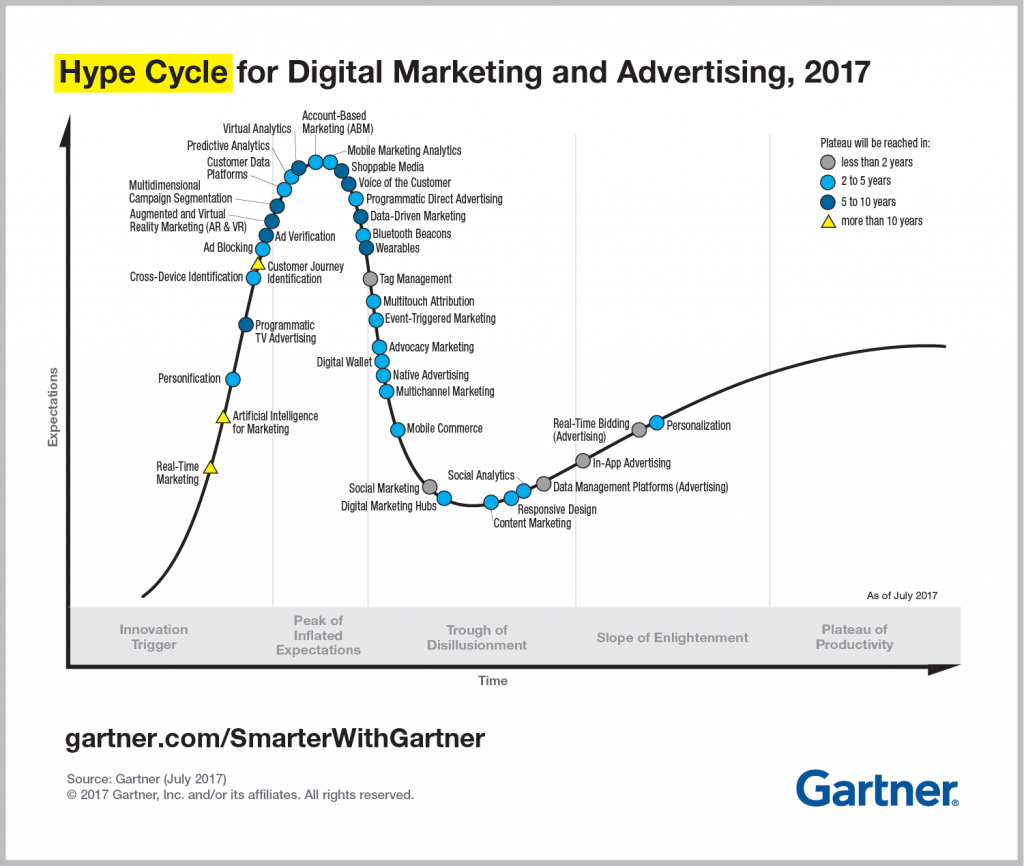
Gartner’s Hype Cycle

Gartner’s hype cycle is visual representation of where a specific product or technology is found in its life cycle. This enables a company to evaluate the technology’s maturity and potential to grow or decline in the future. The cycle includes 5 overall phases. The first phase is technology trigger. The second phase is the peak of inflated expectations. Next, the third phase is trough of disillusionment. Fourth is slope of enlightenment. Plateau of productivity comes last. Bryan Burke, research Vice President at Gartner, defines the hype cycle in the following quote. “The 2019 Hype Cycle highlights the emerging technologies with significant impact on business, society and people over the next five to 10 years,” he says. The 5 trends in the 2019 model are as follows: sensing and mobility, augmented human, postclassical compute and comms, digital ecosystems and advanced AI and analytics.

            The first trend, sensing and mobility, includes evolving technologies. For example, flying vehicles, drones, and AR clouds. These products are possible in a range of different industries.

            The second trend, augmented human, are referring to technologies that related to cognitive and physical aspects of the human body. The example the Gartner website gives for this trend is a prosthetic arm that increases strength.

The third trend, postclassical compute and comms, include technologies that are improved. Examples include better memory on devices and 3D printing.

Digital ecosystems is the fourth trend. This includes anything connecting people to sharing a platform.

Advances AI and analytics is the last trend, which includes technology that analyzes data through algorithms.

I believe Caffeine TV is beyond the innovation trigger stage. It may be approaching inflated expectations. As time passes, users will start demanding better quality and improved capabilities.

If you’re interesting in learning more about Gartner’s Hype Cycle, click on the link below
https://www.gartner.com/smarterwithgartner/5-trends-appear-on-the-gartner-hype-cycle-for-emerging-technologies-2019/

Tags
Audience
Video Games
Caffeine
Sports
Entertainment
Hype Cycle Media
Twitch
Mixer
Social Media

Target Audience

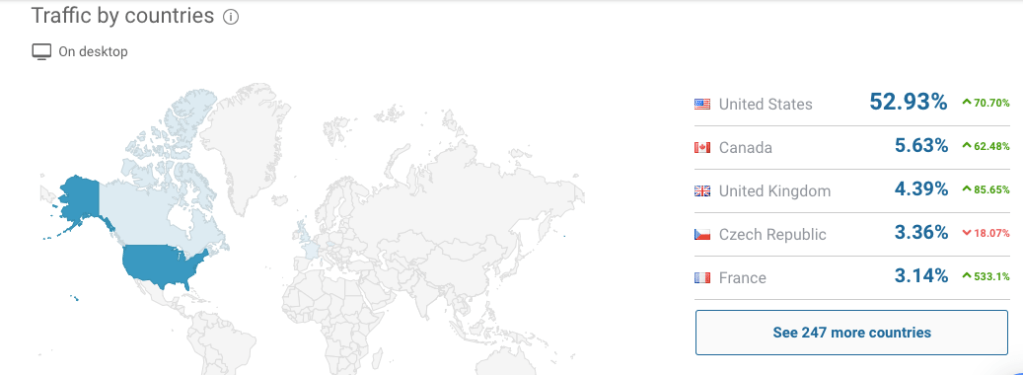
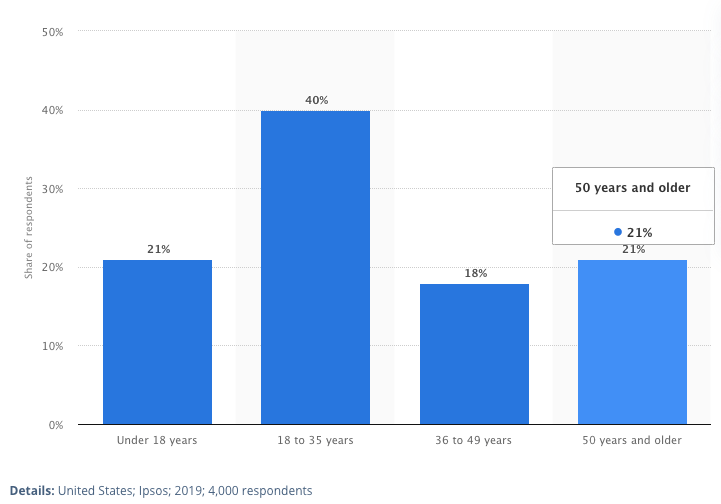
Caffeine’s main target audience includes young adults and teenagers as well as people interested in gaming, arts and entertainment. According to Statistica.com, Americans ages 15-19 years old spend an average of 49 minutes gaming or on the computer during weekdays and an average of 90 minutes on weekend days. Originally, gaming was predominately done by males. However, over time, the industry has attracted more female gamers. It is estimated that 49%, roughly half, of gamers are female. Another study found on statistica.com was done involving 4,000 respondents. The study showed that 21% of the gamers were under 18 years old, 40% were 18 to 35 years old. These two age groups are the primary audience for Caffeine due to the “young mindset.” These groups are more willing to spend their time and money industries such as gaming, entertainment and sports. The study also showed that 18% of gamers were 36 to 49 years old. Surprisingly, 21% of gamers were 50 years old or older. However, the two older groups of gamers were found to spend much less time gaming. Ben Keighran, the founder of Caffeine TV, spoke on the industries lead competitor, Twitch. “That’s why you hear them trying to do an NBA deal, or a Thursday Night Football deal. But all the top content is hardcore gamers. Not even entertainment gamers, but like hardcore gamers,” he said. This statement confirms that a huge portion of their target audience is gamers. Keighran also talked about their newest partnership with Offset. Offset is known as a rapper in the group Migos and has a huge social media presence and influence. He also considers himself a gamer. Caffeine has utilized this partnership to tie together gaming, sports and entertainment. Offset’s social media influence will benefit caffeine because a huge portion of caffeine users come from word of mouth on social media. Offset’s influence on the younger generation due to his role in society will help attract more of their target audience toward caffeine.tv. It is certain that the audience they’re looking to attract are primarily American teens and young adults. In order to take caffeine to the next level, it will be important to incorporate other strategies or partnerships that will attract more people from other locations around the world.

Watch this video featuring Offset as he talks about Caffeine TV!

That’s why you hear them trying to do an NBA deal, or a Thursday Night Football deal. But all the top content is hardcore gamers. Not even entertainment gamers, but like hardcore gamers.

Ben Keighran via theverge.com

Tags
Audience
Video Games
Caffeine
Sports
Entertainment
Hype Cycle Media
Twitch
Mixer
Social Media

Competitors

Caffeine is one of the latest emerging live streaming platforms. It is geared toward the gaming, entertainment and sports industries. The platform was created in 2017 by Ben Keighran, who used to work as a designer for Apple. It was pre-released for two years, then it was officially released in 2019. Caffeine serves as a marketing and advertising tool because it allows users or businesses to broadcast live, enabling them to promote anything including brands.

There are already other platforms that offer similar streaming services, which makes is a little more difficult for Caffeine to differentiate their product from the others that have already saturated the market. The main competitors are Twitch, Mixer, YouTube Gaming as well as Facebook Gaming. The biggest competitor and someone that Caffeine’s team should take notes from is Amazon’s Twitch. Twitch was one of the first major successful streaming platforms. When it was first launched in 2011, it was made to attract gamers. Over time, the Twitch team has tried to expand their audience to other groups by including streaming related to music, shows and art. They were bought by Amazon in 2014. They are now known as the largest, most successful platform in the live streaming industry. They get 140 million views each month.

Mixer, another major competitor, was originally known as Beam when they first launched in 2016. They were taken over by Microsoft in 2016, who eventually renamed them Mixer in 2017. They have averaged over 2.6 million visits to their website each month.  They are known for having real-time streaming, with no delay from the actual streamer and the viewer’s video. They leveraged their platform by partnering top talent and well-known gamers like Cory “King Gothalion” Michael, Michael “Shroud” Grzesiek and Tyler “Ninja” Blevins. These partnerships have brought a lot of attention to Mixer and expanded their audience.

Facebook Gaming has also caught interest of the market. It is known for having the biggest growth spurt in the industry. Their growth is primarily related to their partnerships with popular gamers Jeremy “DisguiseToast” Wang and “ZeRo.”

            The main tactic the other competitors have used to trigger their success involves partnership with the top gamers. Since Caffeine is looking to include other streaming options such as entertainment and sports, it would also be useful to partner with other major influencers to expand their audience and gain more attention.

To see more data on Caffeine TV’s competitors, check out the link below
https://www.statista.com/statistics/189582/age-of-us-video-game-players-since-2010/

The future of live television is at stake and I… it’s just hard to leave that up to Amazon and Facebook.

Ben Keighran via theverge.com

Tags
Audience
Video Games
Caffeine
Sports
Entertainment
Hype Cycle Media
Twitch
Mixer
Social Media

Discover WordPress

A daily selection of the best content published on WordPress, collected for you by humans who love to read.

Longreads

Longreads : The best longform stories on the web

WordPress.com News

The latest news on WordPress.com and the WordPress community.

Design a site like this with WordPress.com
Get started